Family History Research: Will there be anything to find?
In eighth grade, my social studies teacher assigned a family tree project. I asked Mom and Dad for their grandparents’ names, created my first Ancestry.com account, and within days, got a hints email in my (now defunct) theaterstar@comacast.net inbox.
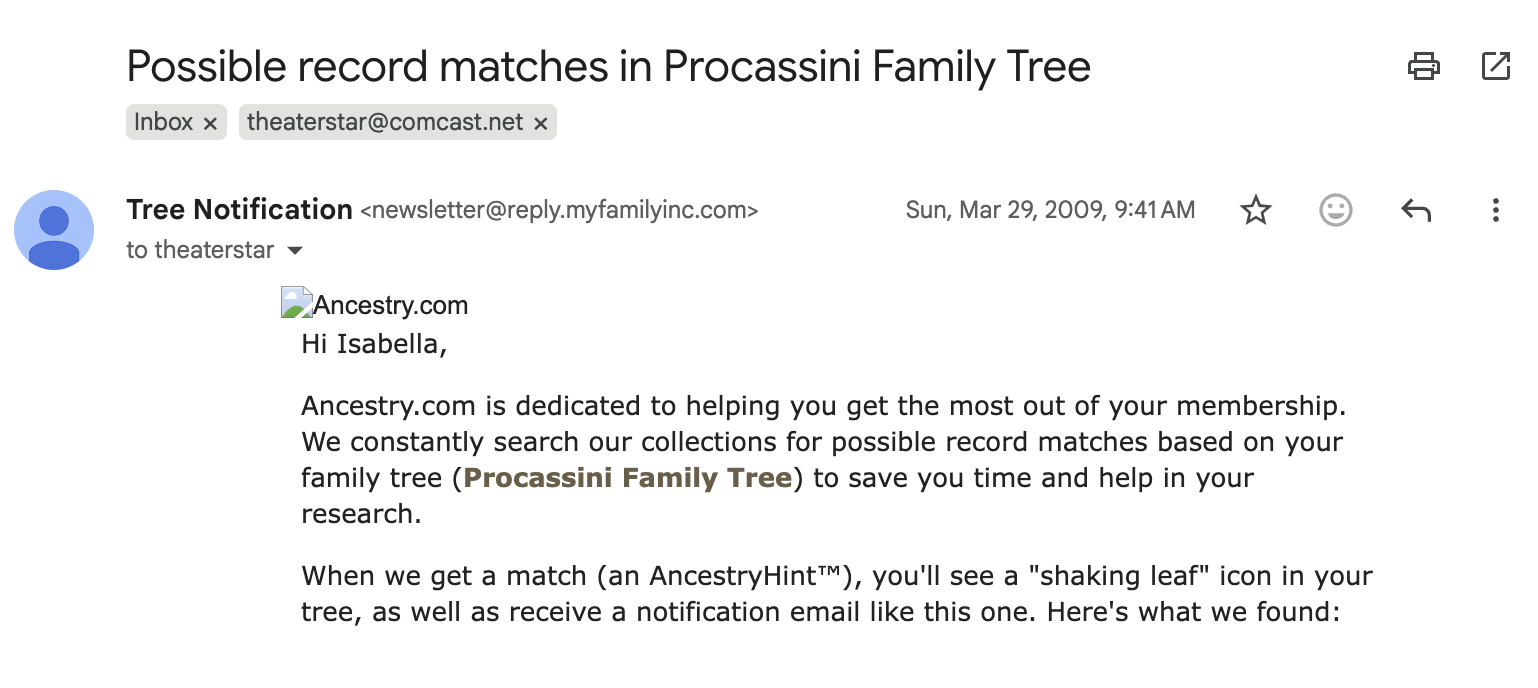
Prior to receiving that email, and likely even after it, I assumed there would be little to find on my ancestors. To me, history was made up of major players, not everyday people. On my mother’s side, my great-grandparents had immigrated from Mexico to Texas and settled in Michigan by the 1920s, where they worked as railroad laborers. On my father’s side, I descended from early settlers to Michigan and Italian immigrants who came to the U.S. in the early 1900s.
My eighth grade presumption that there would be little to find was partly true, but it was more likely due to the volume of material that had been digitized in 2009, not a lack of records. At the time I was searching, Ancestry.com had completed a multi-year project to upload and manually transcribe census records through the 1930s, and in three years, they would add the 1940 census and launch Newspapers.com. Digitization was, and in many cases remains, a time-intensive task, but between then and now, access to materials has greatly expanded.
The rise of DNA testing in the 2010s brought me back to family history. I started a new tree at the same time I was finishing a history major at Northwestern University. Over the following years, I’d get to know my family through census records, draft registrations, city directories, obituaries, and articles. I became interested in mapping not only my tree, but also the community of people surrounding my family. In digital archives, I found connections like the newspaper guild president who made sure my grandfather kept his job as a shoeshiner during the Great Depression and the witnesses to my great-grandparent’s marriage in Texas.
Historical research has always appealed to me because of the thrill of discovery, but more than that, it has allowed me to build greater empathy for people and times that came before my own. I still spend lots of time in digital archives, often with the aim of writing essays which interweave research and reflection. I strive to connect with others through this work, too.
If you are interested in learning more about family history research, whether for biological or chosen family, and don’t know where to start, please send me a note. Let’s learn something new about the past together.
